By Liz Gilmour Solutions Sales Consultant, Graphic Communications Group, Ricoh Europe
Ricoh Europe, London, July 9 – While nearly 80% of the printing industry wants to automate to improve efficiencies, over half (52%) of businesses are still running legacy or manual systems according to Ricoh’s ‘The Automation Gap’ research.
With the greater need to account for every second of print productivity, and understand ways to improve efficiencies, and, with mounting pressure on profitability, operations can no longer afford not to invest in workflow automation.
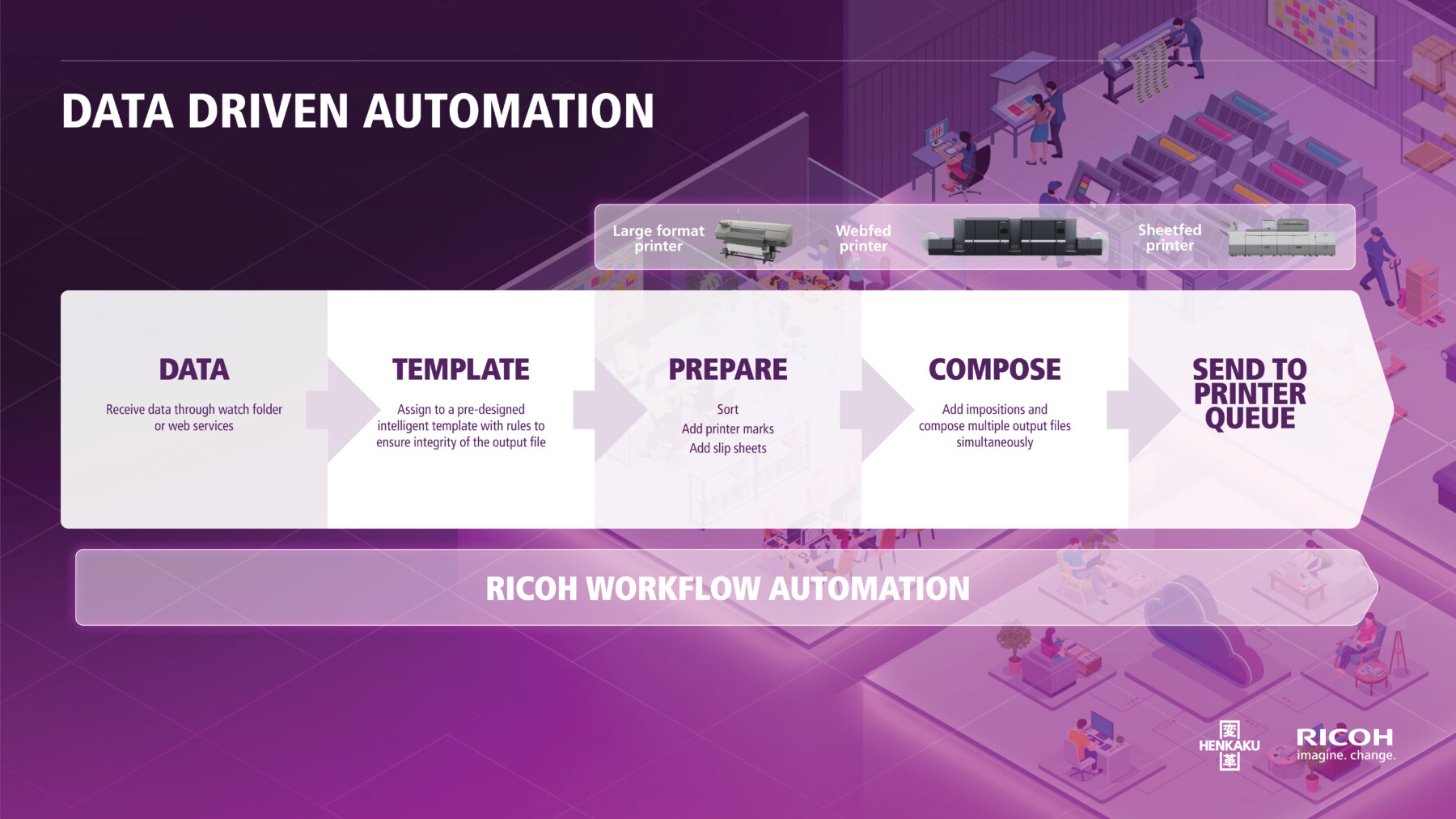
This is the third and final blog in a series exploring why now is the time for Print Service Providers (PSPs) to enhance their workflow automation and how they can capitalise on opportunities to stay competitive. The first [LINK] focused on cloud driven automation. The second [LINK] explored data driven automation. This will expand on process driven automation.
Process driven automation enables clients to improve efficiencies across multiple pre-press, production, and post-press led stages, automating complex and intensive production tasks in demanding environments.
It can manage the:
- Receipt of jobs through multiple ways and assign them to the right workflow.
- Automation of pre-production activities such as imposition and preflight.
- Batching, aggregating, grouping, sorting and splitting for production efficiencies.
- Provision of job management with full tracking at the page level and manage multiple output devices both offset and digital.
- Integration of a wide range of third party business solutions and variable data software for data driven output.
Process driven automation streamlines steps, and minimises touchpoints, from input to finishing and provides a single point of control for all types of work. It brings efficiencies across multiple production stages for clients who have more complex workflow needs.
For example, for transactional print, it enables postal optimisation, print and insertion tracking, and archiving, and, for books it provides cover led workflows, management and tracking of all sections across print and bindery, and reconciliation to ensure 100% accuracy of the finished piece.
For graphic arts specialists, workflow automation is designed for both offset and digital environments. It facilitates the transition from traditional analogue to digital printing with proven, scalable, agnostic core technology to streamline processes and minimise touchpoints. Automatic preflighting, just in time dynamic imposition, job batching, and automatic job routing are just a few benefits. There is also seamless integration of third party solutions such as VDP tools like FusionPro, and MIS.
It provides one point of control for all types of work, regardless of source. It delivers a single view of all production with live status updates plus advanced production analytics.
What difference could that make for your operation? What minute by minute savings could be made? What operational improvements could be implemented? Talk to Ricoh and discover more about how process automation could be transformative in making your work flow.